Cloud Stack Backlinks, Built Clean — No Authority Myths
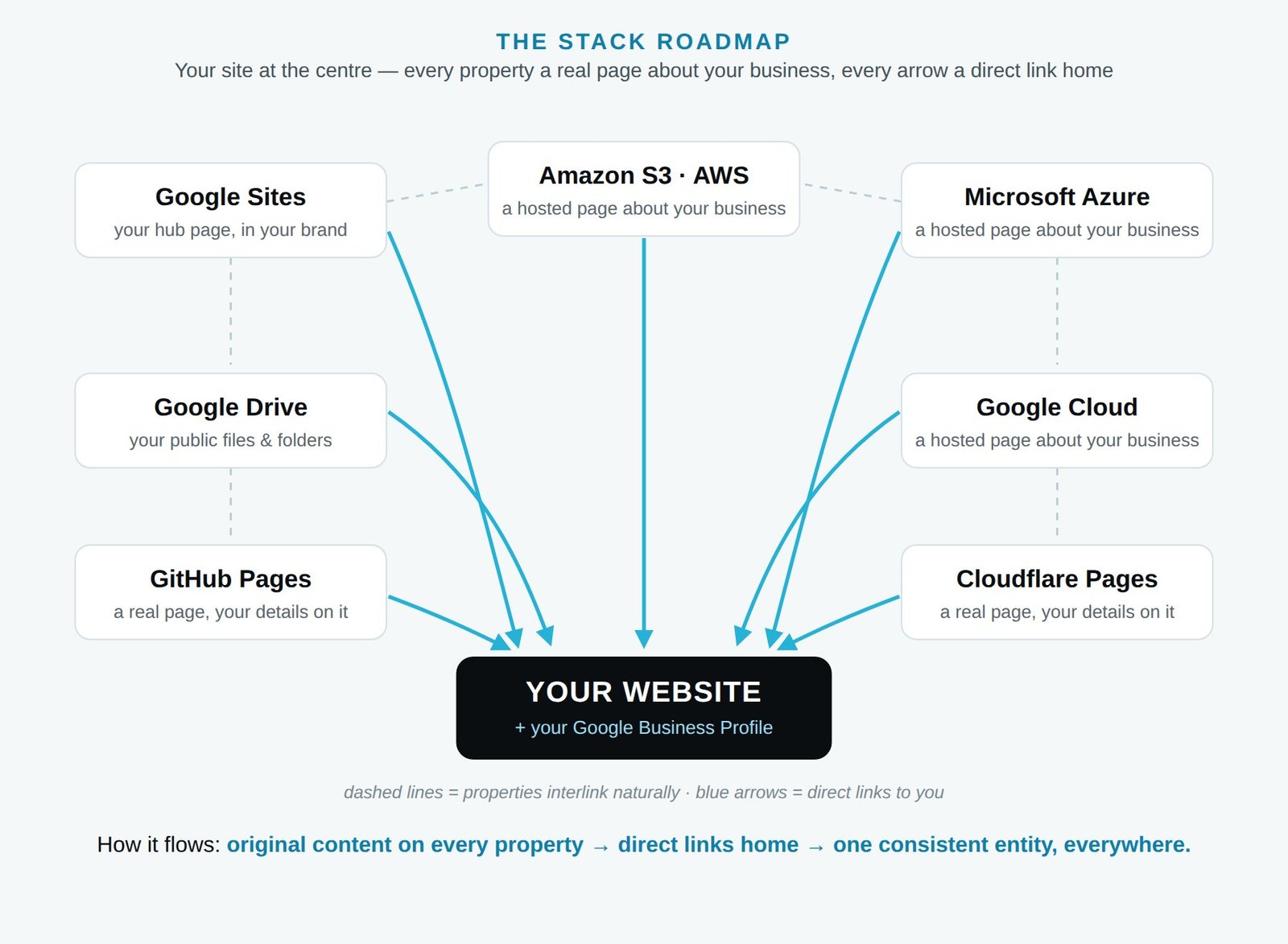
A cloud stack is a set of branded pages about your business, hosted on the world’s biggest cloud platforms and linking back to you. Sold honestly, it is a clean entity layer that supports your SEO. Sold the usual way — as “borrowed DA 100 authority” with 500 tier-2 blasts — it is a link scheme with a cloud logo. This page only sells the first kind.
What is a cloud stack backlink, in plain words?
A link from a page you publish on a major cloud platform — Google, Amazon, Microsoft and similar services — pointing to your website. A set of these branded pages forms a “stack”. Example: a plumber has a page on a cloud platform describing his services, areas and contact details, linking to his site and his Google Business Profile. Several such pages, consistently written, reinforce who the business is and what it does — and each carries a link home.
What I’ll do: I’ll plan a focused stack for your business, write an original page for every property — your real services and details — link them directly and naturally to your site, and hand you every live URL and every login.
A cloud page is judged as a page — not by its landlord.
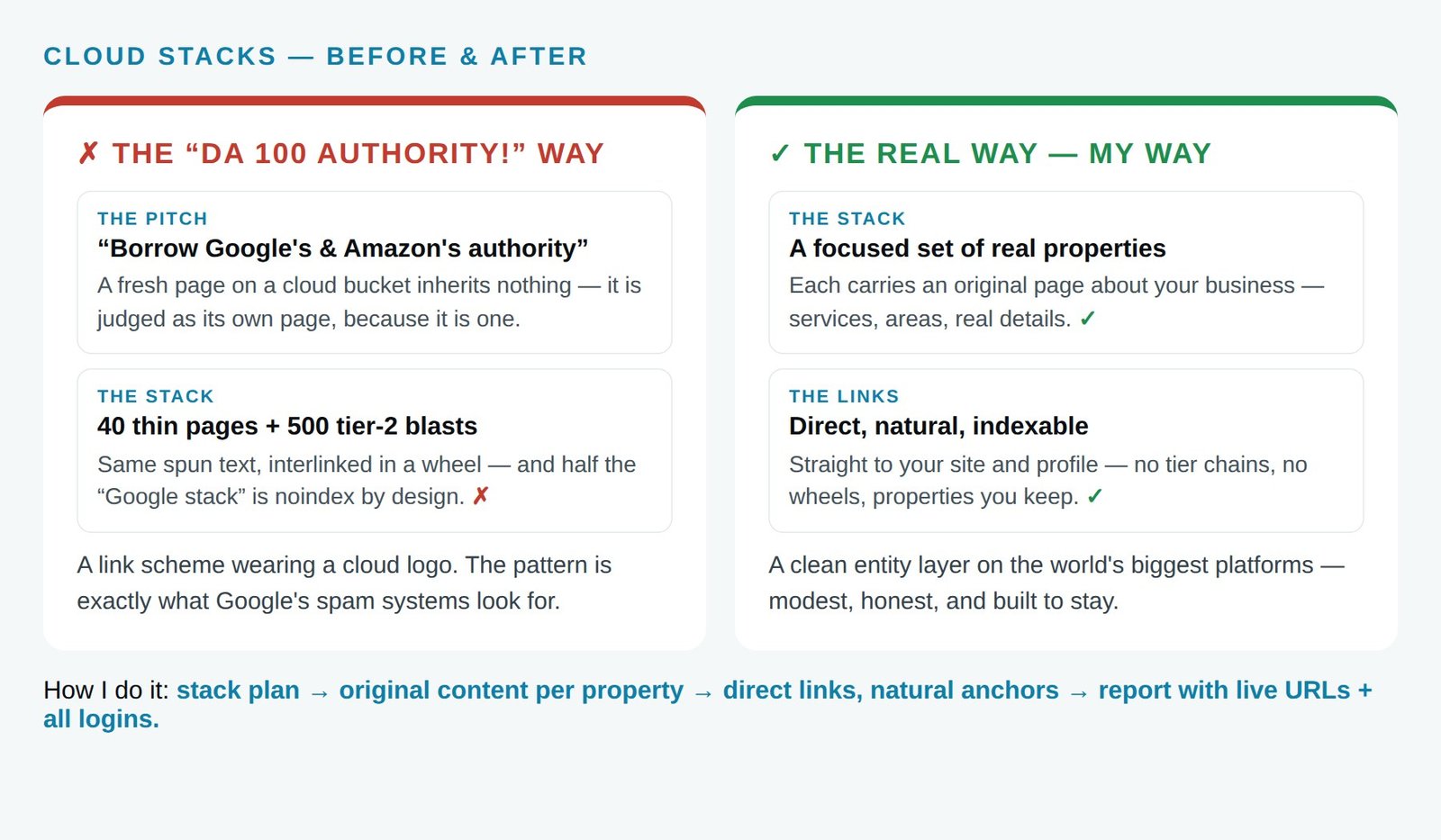
The stacking pitch claims a fresh page on Amazon or Google “inherits” the giant’s authority. It doesn’t: a storage bucket you created this morning has no audience and no endorsements, and search engines treat it as its own property. Worse, much of the classic “Google stack” — published Docs, Sheets and Drive files — is served with a noindex instruction, so it cannot pass anything at all. Add 500 tier-2 spam links and a spun-content wheel, and the “advanced technique” is a textbook link scheme:
Entity consistency
Your business described identically — name, services, areas, details — across major platforms. That consistency is a real signal about a real business.
Local support
Stack pages can link to your Google Business Profile as well as your site — a recognised supporting layer for local visibility.
A foundation, not a shortcut
Branded properties under your real links make a profile look established and complete — the honest ceiling of what a stack does.
The clean version, in full — nothing hidden in tiers
A Stack Plan Matched to Your Goal
Local entity support, brand foundation, or profile completeness — the platforms and count follow the goal, not a fixed 7-phase spectacle.
Original Content Per Property
Every page written uniquely about your business: services, areas, real details. No spun text repeated across the stack — ever.
Direct Links, Natural Anchors
Links point straight to your site and profile — brand and natural anchors, a keyword link where it fits. No tier chains, no wheels, no blast layers.
Report + All Logins
Every live URL and every account login. The stack is your property, under your control, from day one.
Stacks are a supporting layer — the ranking weight comes from link building inside a complete off-page SEO service.
From your business details to a live stack, in four steps
Send your business details
The free check: your goals, your targets, and a concrete stack plan with the platform list.
Properties created
Each platform set up under your brand, with its own original page of content.
Links live
Direct, natural links to your site and profile — and indexing checked, not assumed.
Report + logins
Every URL and login handed over. Your stack, yours to keep and extend.
Should you even buy a cloud stack?
You need one if…
- You run a local business and want entity and Business Profile support
- Your brand is new and needs a consistent footprint on major platforms
- You want a foundation layer underneath your real link building
- You understand it is a modest, supporting signal — and value it as such
You probably don’t if…
- You believe the “DA 100 inheritance” pitch — that is not how any of this works
- You want tier-2 blasts and interlinked wheels — that is the risky pattern, and I won’t build it
- You expect a stack to replace editorial links and guest posts
I would rather sell you a smaller stack that stays indexed and safe than a seven-phase spectacle that impresses in a report and does nothing in search.
Who gets the most from a clean stack?
Local businesses
The strongest case: entity consistency plus Business Profile support across platforms your customers’ searches touch.
New brands
A complete, consistent branded layer from the start — the footprint an established business is expected to have.
Agencies building foundations
A clean stack per client, delivered with logins — a foundation your clients own, not a rented network.
Don’t want to pick services one by one? Take my complete off-page SEO service — I decide the order and handle everything.
Why stacks get built by me
The myth, refused
You will never hear “borrowed authority” from me. You get the real mechanics, in writing, before you pay.
Built to stay indexed
Indexable properties, original content, indexing verified — a stack that exists in search, not only in a spreadsheet.
Yours, completely
All logins, all URLs. If we never speak again, your stack keeps working for you.
Wondering if a stack fits your site? Ask me — free.
Book a free 15-minute call. Tell me your goal beforehand and I will bring a concrete stack plan — or a straight “you don’t need this” if that is the truth.
Book My Free CallQuestions, answered straight
No — and this is the fact the whole sales pitch hides. A page you create on a cloud platform is judged as its own page. A fresh storage bucket has no audience, no relevance and no endorsements of its own; the root domain’s famous metrics belong to the root, not to your bucket. Honest practitioners in this space say the same: the value of a cloud page comes from its content, its relevance and whether it is indexed — never from its landlord.
Mostly, they cannot: published Google Docs and similar files are served with a noindex instruction, which means search engines are told not to index them — and a page that is not indexed passes nothing at all. A large part of the classic “Google stack” is invisible to search by design. In my stacks I use properties that can actually be indexed, and I verify that they are.
It depends entirely on which version you buy. Mass stacks — dozens of thin pages, spun text, interlinked wheels, hundreds of tier-2 spam links pointed at them — match the link-scheme pattern in Google’s spam policies, and I will not build them. The clean version is different in kind: a focused set of properties with original content, real business details and direct links. That is the only version on this page.
Three modest, real things: entity consistency — your business described the same way across the world’s biggest platforms; support for local visibility, including links to your Google Business Profile; and a foundation layer of branded properties under your stronger links. Stacks support a strategy. They do not replace editorial links, and I sell them as support, in writing, before you pay.
Yes. Every property is created under accounts whose logins come with your report. Update the pages, add to them, or reuse the accounts later — the stack is your asset, not something rented from me that vanishes when we stop working together.
A focused set, matched to the goal — enough platforms to establish the entity layer properly, each with genuinely original content. The moment a stack’s size becomes the selling point, quality has already lost: forty thin pages are worth less than a smaller set of real ones that stay indexed. The free check ends with a concrete plan and count for your business.